


I want to talk about a product with possibly the most confusing name in all of lighting. It’s not glamorous. It’s not something you’d see in an interior design magazine. But it might be the single most cost-effective commercial lighting swap you can make — and if you’re still running metal halide or HID fixtures in your warehouse, parking lot, or gym, it directly applies to you.
It’s called a corn bulb. And yes, the name is exactly as weird as it sounds.

Okay, Why Is It Called a Corn Bulb?
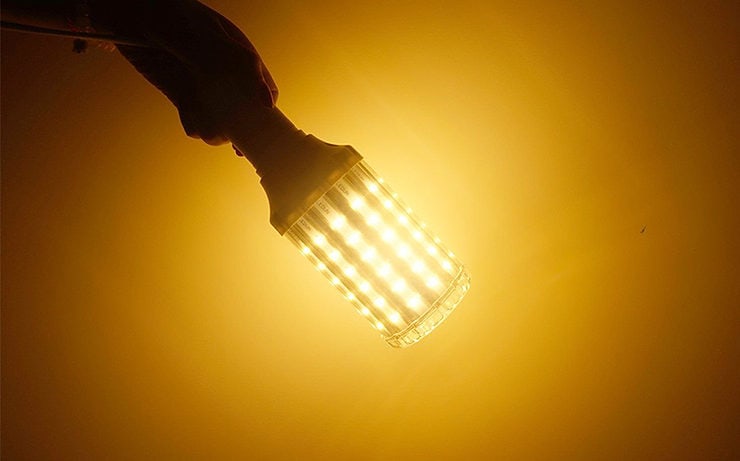
Look at one in person and it clicks immediately. The bulb is covered in small LED chips arranged in rows around a cylindrical base; Rows that, from a distance, look a lot like the kernels on an ear of corn. That’s it. That’s the whole reason. It’s not a technical term. It’s just what the thing looks like, and the name stuck.
The actual product category is LED HID retrofit lamp, which is considerably less memorable. Corn bulbs are designed to replace High-Intensity Discharge (HID) lamps — the broad category that includes metal halide, high-pressure sodium, and mercury vapor lights. These are the big, bright, often-yellowish lights you’ll find in warehouses, parking garages, gymnasiums, streetlights, and large retail spaces. The kind of lights that take five minutes to warm up after you flip the switch.
What’s Wrong With HID?
Nothing is exactly wrong with HID—it’s been a reliable workhorse for commercial lighting for decades. The problem is that LED technology has lapped it completely, and the gap keeps widening.
HID lamps have a rated life of around 15,000 to 20,000 hours. LED corn bulbs last 50,000+ hours—more than double, often triple. HID fixtures require a ballast to operate and typically lose 15–20% of their light output to the ballast itself. They also experience significant lumen depreciation over time, meaning a three-year-old metal halide fixture might only be putting out 60–70% of its original brightness even if the bulb hasn’t burned out yet. And then there’s the warm-up time: HID lamps need several minutes to reach full output, which matters more than people realize in spaces where lights get switched on and off.
Corn bulbs solve all of this. Instant on, full brightness from the first second. Energy consumption 50–80% lower than equivalent HID. No ballast losses. Light output that stays consistent over the full rated life. And in most cases, a corn bulb drops directly into the existing HID fixture housing—no new fixture required.

What to Know About Base Types
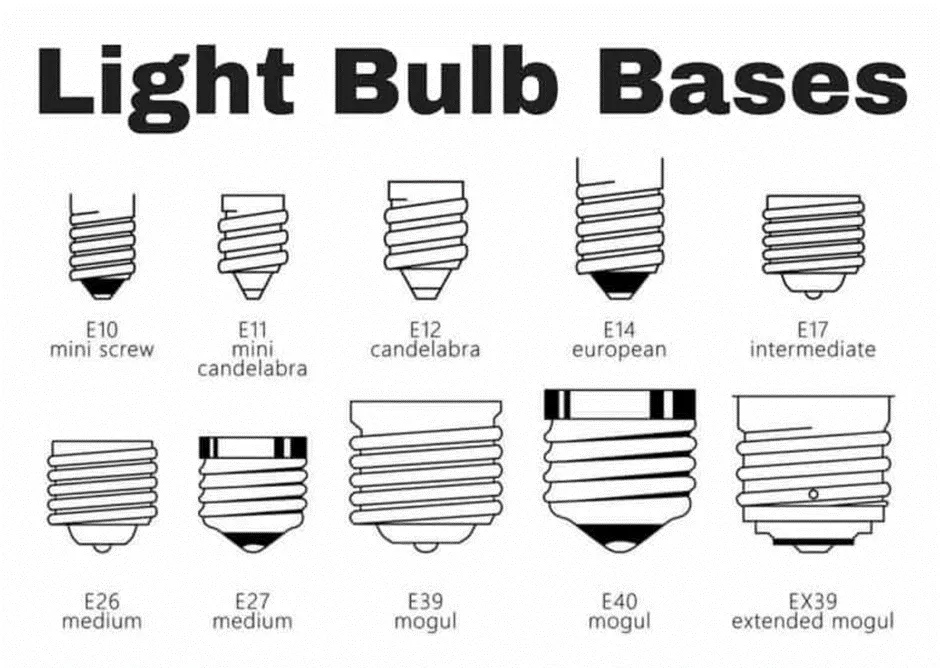
This is where facility managers and contractors sometimes get tripped up. Corn bulbs come in two main base types, and getting this wrong means the bulb literally won’t fit.
E26 is the standard medium base—the same size as a regular household bulb. This is used in smaller HID fixtures, typically 100W and under, in applications like post-top outdoor lights, wall sconces, and smaller commercial pendants.
E39 is the mogul base. It is significantly larger, designed for high-wattage commercial and industrial fixtures. If you’re looking at a warehouse high bay, a parking lot pole light, or a streetlight, you’re almost certainly dealing with an E39 socket. Sunco’s corn bulbs go up to 120W at 15,600 lumens in the E39 mogul base, which replaces a 400W metal halide lamp.
Before ordering, check your existing fixture’s socket size and the wattage of the lamp you’re replacing. Most HID-to-LED manufacturers publish equivalency guides, but the general rule is that a corn bulb uses roughly 40–50% of the wattage of the HID lamp it replaces while delivering equal or better light output.
Real-World Applications
Warehouses and distribution centers are the most common use case. A 150W metal halide high bay running 12 hours a day costs significantly more to operate annually than a 45W corn bulb delivering the same or better lumen output. Across a facility with 50 or 100 fixtures, that’s a number worth running.
Parking structures and outdoor lots are another strong fit. High-pressure sodium lights—the ones that cast that orange-yellow glow — are notoriously inefficient and deliver poor color rendering. Corn bulbs in the same fixtures produce white light with much better CRI, which improves security camera footage quality as a side benefit.
Gymnasiums, recreation centers, and large retail spaces often run metal halide for the high lumen output and color rendering at ceiling heights of 20 feet or more. Corn bulbs handle these applications cleanly, and the instant-on characteristic is especially valuable in gyms where lights get cycled frequently.

The Installation Reality
Most corn bulb retrofits involve bypassing or removing the existing HID ballast and wiring the fixture for direct line voltage—similar to a Type B LED tube retrofit. In some cases, plug-and-play options exist for specific ballast types, but ballast bypass is the more reliable long-term approach and eliminates a future failure point.
For a facility doing a large-scale retrofit, this is typically a half-day job per zone for an electrician. The payback period on corn bulb retrofits usually runs 18 months to three years depending on utility rates, usage hours, and whether rebates are available — which they often are, since utility companies actively incentivize HID-to-LED conversions.
Sunco’s corn bulb line runs from 16W (replacing 50W HID) all the way to 120W with a mogul E39 base (replacing 400W metal halide), all rated at 50,000+ hours with a 5-year warranty. If you’re still running HID anywhere in your facility, it’s probably time to do the math.
All comments 0