Sunco resources

Resources

Find product documentation, lighting education, certifications, and compliance resources.

Resource library

Use these resources to verify, install, and understand Sunco products.

Light Wattage

Watts measure energy usage or how much energy is consumed. The standard in previous years was to shop for lights using their wattage. Example: a 60W bulb consumes 60 watts of energy.

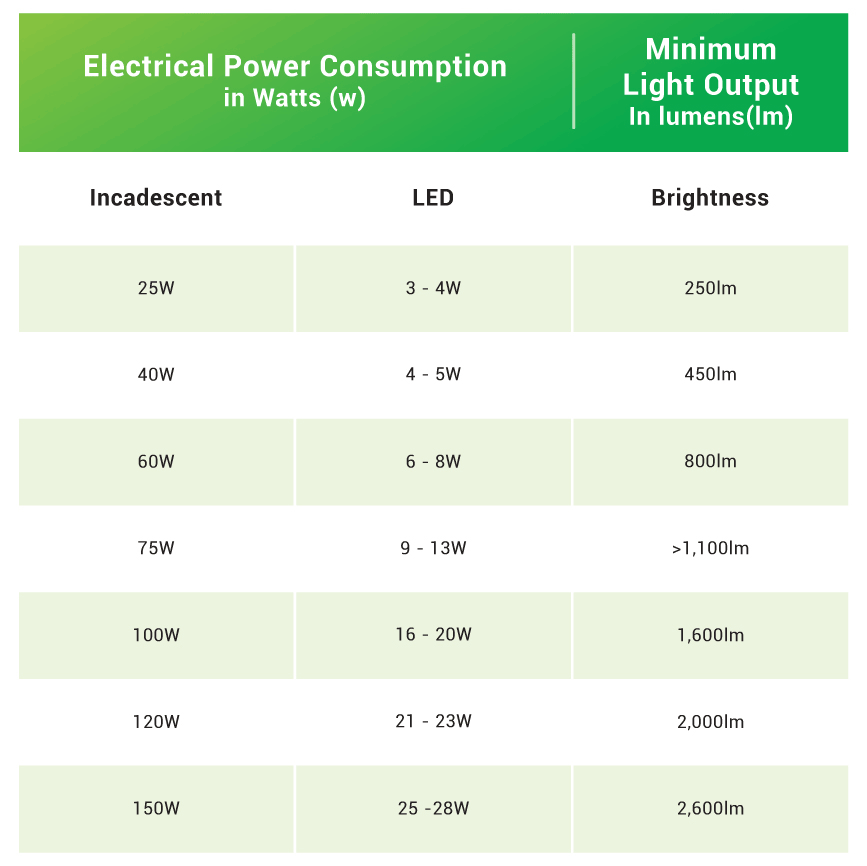
Remember that watts do not reflect the brightness of a light. If you want to measure the brightness of a specific bulb, look at the Lumen output. LEDs provide more light (lumens) while using less energy (watts). This energy conservation is noticeable when you compare a Sunco BR30 LED bulb with 11W of power consumed vs. an equivalent 65W Halogen lamp.

Wattage Equivalent Explained

LEDs consume fewer watts than an equivalent incandescent bulb. That is why LEDs include details about wattage equivalency. It allows you to compare more power efficient LED lights against an incandescent bulb.

Chart comparing incandescent and LED wattage with minimum lumen output

How well a bulb converts watts (energy) into lumens (light brightness) is called luminous efficacy, which is sometimes just referred to as efficacy.

In general, an LED produces 60 lumens (lm) per watt. Check out the technical specs on individual products on this site for precise measurements of each Sunco LED bulb.

What are Lumens?

Lumens refers the amount of brightness a bulb emits or its output; lumens is a measurement of the quantity of visible light emitted from a single bulb. Lumens are a way we can express how lights of equal power, but different wavelengths, are not as bright.

You will see lumens in technical specs with the letters “lm” after a series of numbers. Fewer lumens means a dimmer light is emitted. The higher the number, the brighter the bulb.

Americans used to buy their light bulbs based upon the amount of wattage1. If you focus on the lumens instead, you can purchase lights that produce the amount of light you need for specific uses. The more lumens, the brighter the light produced.

1 Watts measure energy usage, rather than brightness.

Color Rendering Index (CRI)

Color Rendering Index (CRI) is shown on a scale of 0-100. CRI indicates the faithful reproduction of an object’s color when under that light source versus when viewed under a natural light source. In this measurement, 100 is shown as the closest to natural or sunlight quality.

Comparison showing more vivid, accurate colors under CRI 90-plus lighting than CRI 80-plus lighting

LED light bulbs in the CRI 80 – CRI 89 range produce an accurate color rendering and are considered good. LED lights in the CRI 90+ range are considered to have an excellent color rendering ability. In contrast, fluorescent bulbs produce an unnatural light quality and range in low numbers on the CRI scale.

Sunco products usually run from CRI 80 – CRI 95.

In addition to accurate color, high CRI also makes the textures of an item stand out. This means LEDs are the ideal answer for indoor light that needs to represent both accurate color and clear definition.

Want to improve customer satisfaction with your products? Light them in the high CRI range to ensure accurate representation of the product’s color and texture.

Think about what your clothes look like in a retail dressing room or a retail display area versus wearing those same clothes outside in sunlight. Also, consider how food can appear in your kitchen prep area or a dining room or on a candlelit table, versus serving that same plate in outside natural daylight. What you are seeing is the representation of CRI and color temperature (on the Kelvin scale) in your everyday life.

Kelvin & Color Temperature
Absolute color temperature is measured in degrees of Kelvin (K) on a scale from 1,000 to 10,000. This measurement allows you to describe the quality of a light. Typically, in commercial and residential lighting applications, Kelvin temperatures fall somewhere on a scale from 2000K to 6500K. When you want a specific look and feel in a room, choose the color temperature that best suits your project’s needs. The lower the temperature, the warmer the look; the higher the temperature, the cooler the look. Color temperature scale from warm amber 2200K through daylight 5000K to cool diamond white 7000K

Sunco color temperatures include:

2000K
(Warm Amber Glow)
Appears: Red
2200K
(Amber Glow)
Appears: Red
2700K
(Soft White)
Appears: Orange
3000K
(Warm White)
Appears: Yellow
4000K
(Cool White)
Appears: White
5000K
(Daylight)
Appears: Blue
5500K
(Daylight Glow)
Appears: Blue
6000K
(Daylight Deluxe)
Appears: Silver
7000K
(Diamond White)
Appears: Silver
You may see the term Correlated Color Temperature (CCT) used when discussing light or while referencing technical specs. This is a way to measure a light’s appearance in the warmth or coolness of the light emitted.

It helps to understand the concept of CCT when you consider what happens when a blacksmith heats a piece of metal or when metal is melted for industrial purposes. Of course, LEDs do not heat in this manner, but let’s examine this for reference purposes to see how heating can change the color and appearance of an object.

  • When metal is first heated – still at a relatively low temperature – the metal turns an amber/red hue.
  • Heated metal that is ready to be shaped or worked by a blacksmith is a warm white with a slight tinge of yellow (such as our 3000K color temperature).
  • Liquid metals are a bright white or silver (which relates to the Daylight quality of 5000K-6500K+). Though the metal itself is piping hot, the color of the metal is cooler in tone and quality.
Ingress Protection (IP) Rating
Ingress Protection (IP) is a measurement of the protection or shield an item will have against both solid objects and liquids. Because of this combination, an IP rating includes two numbers, both of which provide information about the protection level. A higher number means greater defense.

IP ratings symbol for protection against solids and moisture
The first number (0-6) refers to the level of protection against solid objects and moving parts, such as dust, debris, or other solid matter.

The second number (0-8) references the level of liquid and moisture protection.

Here are a few examples:

IP65 = Water resistant

“Protected against water jets from any angle”

NOTE: Do NOT submerge IP65 LED lights, these are not waterproof.

IP67 = Water resistant plus

“Protected against the events of temporary submersion (10 minutes)”

NOTE: Do NOT submerge IP67 LED lights for extended periods, these are not waterproof.

IP68 = Waterproof
“Protected against the events of permanent submersion up to 3 meters”
Low IP ratings are appropriate for:
  • Protected use inside sealed products
  • Inside sealed signage
  • When using aluminum extrusions

High IP ratings are appropriate for:
  • Unsealed outdoor locations
  • Places with a lot of debris
  • Areas with heavy foot traffic
  • High splash zones
  • High contact areas (people touching the item)
  • Wet locations
Not every product will show an IP rating. Sometimes the terms wet rated or damp rated are used. IP ratings were developed overseas. Americans use wet and damp ratings. Examining all of your light’s certifications can help you purchase a light fixture that is appropriately rated for your needs.
Beam Angles Explained
Beam angle categories from narrow spot below 25 degrees to very wide flood above 90 degrees

When you turn on a light, the beam angle is the angle at which that light is emitted or distributed.

Let’s look at that concept in a different way. This is an image of four lights in a darkened room with four different beam angle sizes.

Four ceiling lights showing beam spreads of 30, 90, 110, and 120 degrees

The smallest light beam spread (30-degrees) is on the left and the widest light beam spread (120-degrees) is on the right. The narrow light beam might be referred to as a spot light, while the wider one could be referred to as a flood light. There are nuances to this, as shown in our leading graphic.

A common misconception is that a wide flood light is a brighter light than a spot. Analyzing the brightness of a light is separate from the measurement of a light beam. Brightness is measured in Lumens.

Let’s examine a single light in a darkened room, like the one shown below:

A 120-degree beam produces a wider floor spread as ceiling height increases from 5 to 15 feet

If you look at only the left or right half of the light beam, you can see that the light creates a triangular shape from the light source (at top) directly down to the center point, then spreads out to the respective side where the pool of light lands on the ground.

In the world of lighting, the beam angle is measured at the points on both sides of the light spread, where the intensity drops in half from the center point (remember our triangle). Say you have a 40° light spread. At 20° on either side of that central point, the light intensity is half the intensity of what appears directly beneath the bulb.
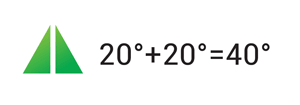
A 40-degree beam angle consists of 20 degrees on each side of the center line

After 40°, some light continues even outside of this range.

Where that 40° light beam lands on the floor is the beam radius (sometimes discussed as light spread). The larger the beam radius or beam width, the less spot-like and more flood-like the light becomes.

We want to help in your decision-making process for selecting the right beam angle for your project. If you install lights at a certain height, how much light will appear on the surface area of your floor?

Here is a sample chart showing Beam Angles (shown in degrees) and Light Spread (feet) for five different ceiling heights.

Chart comparing beam widths for 15, 25, 40, and 120-degree angles across 5 to 15-foot ceiling heights

Want to do this yourself for your unique space? Simply follow this equation:

BEAM WIDTH = ANGLE x .018 x DISTANCE

CEC Title 20 and Title 24

You may have seen a notice on a light sold on the Sunco website that states you cannot buy certain light bulbs in California. The California Energy Commission (CEC) established certain appliance efficiency regulations with Title 20 and building standards with Title 24. Those regulations can limit the sale within California of certain products.

Title 20 affects electrical products of all types, including lamps/bulbs, portable lighting fixtures, torchieres and lighting controls, among other things.

Title 24 (JA8 High Efficacy) provides for specific performance requirements under Joint Appendix, Section 8. It focuses on efficacy, color rendering (CRI), dimming, flickering, and product longevity.

If you want to know more, please review the details for each California regulation using the link provided for your convenience here.

Product resource FAQs

Answers focused on manuals, dimmers, certifications, lighting labels, and technical documentation.

Product Resources
Are your lights and LED bulbs certified?
Many Sunco lights and LED bulbs are certified. Certifications can be viewed in product technical specifications or on the Certifications page.
Can I dim your LED lights?
Many Sunco LED bulbs and lamps are dimmable. Product descriptions and technical specifications show dimming details, and dimmer compatibility information can be found on the Manuals & Downloads page.
What kind of dimmer should I order to go with Sunco LED bulbs?
Multiple dimmer types can work with Sunco LEDs. Visit Manuals & Downloads to view dimmer compatibility lists for dimmable products.